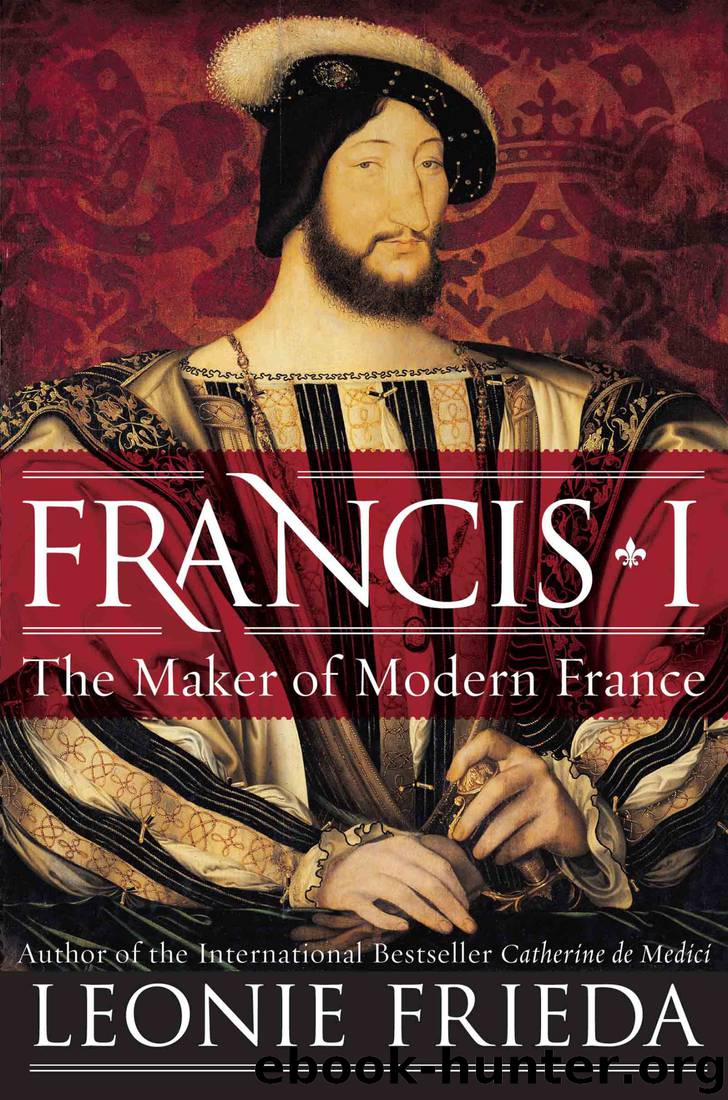
Francis I: The Maker of Modern France by Leonie Frieda
Author:Leonie Frieda
Language: eng
Format: epub
Tags: History, Europe, France, Renaissance
Publisher: HarperCollins
Published: 2018-04-10T03:00:00+00:00
Chapter 13
A King Restored
As her son progressed from despondency to despair and, ultimately, to near-death, Louise was doing her considerable best to ensure that the regency continued as successfully as possible. After her immediate actions had ensured that no threat was posed to France, the regent, whose personal deviousness dovetailed with her country’s and her son’s advantage, realised that a certain amount of intrigue could both discomfit the empire and actually benefit the French cause. Despite the joy with which Henry VIII had greeted the news of Francis’s downfall, it soon became clear that a treaty between England and France was key to Louise’s strategy. It was of considerable help to her that many English diplomats were concerned that a Franco-imperial peace treaty would leave England out on a limb.
Therefore the Treaty of the More, signed with much pomp and ceremony on 30 August 1525, saw Anglo-French relations restored to somewhere near the heights of the Field of the Cloth of Gold, even if one participant languished a considerable distance away. Henry agreed to campaign actively for Francis’s release and, in exchange, Louise promised to pay him a total of two million gold écus, spread in equal annual amounts over the next twenty years. France also promised not to ally with any Scottish territorial ambitions, thus thwarting any forays into northern England. The treaty was an anti-imperial ploy but it was put together with some discretion; it would not do to aggravate Charles unduly. Nonetheless, Louise had spent a great deal of 1525 canvassing assistance throughout Europe. In June she had proposed a new coalition to the papacy and to Venice that would seek to eject imperial forces from Italian soil. The only money on offer was a tiny monthly subsidy, and there was no serious French military commitment, which indicated that Louise was testing international support rather than proposing a serious policy. Even with these strictures in place Venice was still prepared to support the French initiative; the papacy rejected it, however, and the proposal only strengthened Charles’s suspicion of French diplomatic skulduggery, which hardly made him more amenable to the idea of releasing Francis on any lenient terms.
Louise also ventured into international negotiations in a considerably more significant area. Hitherto, the idea that any European Christian ruler might enter into dialogue with the Ottoman Turks, as opposed to launching a crusade against them, was inconceivable. The Christian–Islamic divide was regarded as unbridgeable, given the radical differences between their entirely opposed religions. Francis would place his country’s national interests first in future years and treat with the sultan if that was where France’s advantage lay, but his mother had arrived at this conclusion long before him. One of Louise’s first acts after the disaster at Pavia was to send an ambassador to Constantinople. Upon receiving the envoy, Suleiman I – also known as ‘The Magnificent’ – was duly informed that soon the Emperor Charles could legitimately call himself ‘master of the world’, a state of affairs that would surely imperil the sultan’s own position.
Download
This site does not store any files on its server. We only index and link to content provided by other sites. Please contact the content providers to delete copyright contents if any and email us, we'll remove relevant links or contents immediately.
| Africa | Americas |
| Arctic & Antarctica | Asia |
| Australia & Oceania | Europe |
| Middle East | Russia |
| United States | World |
| Ancient Civilizations | Military |
| Historical Study & Educational Resources |
Room 212 by Kate Stewart(5119)
The Crown by Robert Lacey(4814)
Endurance: Shackleton's Incredible Voyage by Alfred Lansing(4780)
The Iron Duke by The Iron Duke(4354)
The Rape of Nanking by Iris Chang(4211)
Joan of Arc by Mary Gordon(4109)
Killing England by Bill O'Reilly(4001)
Say Nothing by Patrick Radden Keefe(3984)
I'll Give You the Sun by Jandy Nelson(3447)
Shadow of Night by Deborah Harkness(3367)
Hitler's Monsters by Eric Kurlander(3342)
Mary, Queen of Scots, and the Murder of Lord Darnley by Alison Weir(3210)
Blood and Sand by Alex Von Tunzelmann(3203)
Eleanor & Park by Rainbow Rowell(3172)
Darkest Hour by Anthony McCarten(3129)
Margaret Thatcher: The Autobiography by Thatcher Margaret(3082)
Book of Life by Deborah Harkness(2938)
Red Famine: Stalin's War on Ukraine by Anne Applebaum(2932)
The One Memory of Flora Banks by Emily Barr(2863)
